Flight Software Requirements Gap Analysis Tool
Developed an AI-powered tool to assess flight software requirement-set completeness, analyzing 20,000+ requirements across 15+ JPL missions. Built web application for interactive completeness analysis and coverage metrics.
Skills
Overview
During my summer internship at NASA Jet Propulsion Laboratory, I developed a tool to address a fundamental challenge in spacecraft systems engineering: how do you know if a requirements set is complete?
Flight software requirements for space missions can contain thousands of individual requirements. Ensuring that this set comprehensively covers all necessary functionality, failure modes, interfaces, and constraints is critical for mission success—but it’s difficult to assess completeness objectively.
First day at NASA Jet Propulsion Laboratory, Summer 2025
The Challenge
When a systems engineer reviews requirements for a new mission, there’s no straightforward way to validate that the requirement set is complete—that it adequately covers all aspects of the system that need to be specified.
Questions like these are difficult to answer:
- Are we missing requirements in certain functional areas?
- How does our coverage compare to similar heritage missions?
- What gaps exist in our requirement set?
Solution: Requirement Fingerprinting
I developed a tool that works by ingesting a requirement set and comparing its “fingerprint”—how the requirements are distributed across different categories—to heritage missions with similar goals.
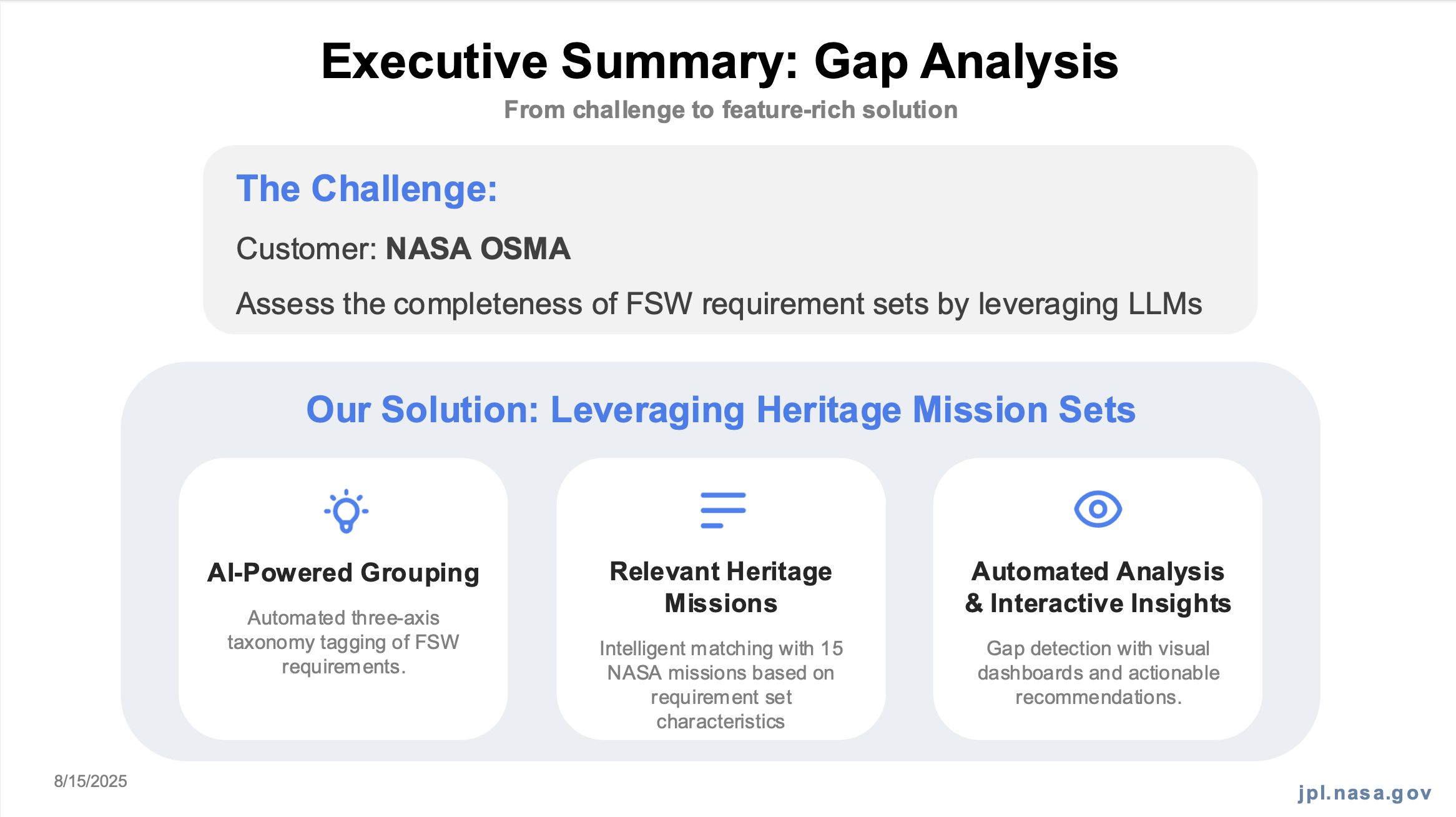
Executive summary: AI-powered solution leveraging heritage mission sets for gap analysis
How It Works
- Ingest Requirements — The tool reads and parses requirement sets from mission documentation
- Classify & Categorize — An AI classification pipeline assigns each requirement to categories in a custom taxonomy
- Generate Fingerprint — The distribution of requirements across categories forms a “fingerprint” for the mission
- Compare to Heritage — The fingerprint is compared against similar past missions to identify gaps
Three-Axis Taxonomy Design
I worked closely with flight software engineers and systems engineers at JPL to design a three-axis taxonomy for organizing requirements. This taxonomy enables meaningful completeness assessment by categorizing requirements along multiple dimensions simultaneously.
The taxonomy was designed to be:
- Comprehensive — Cover all types of FSW requirements across JPL missions
- ITAR-compliant — Enable AI classification using cloud-based models while maintaining security
- Practical — Provide actionable insights for systems engineers
AI Classification Pipeline
I designed and implemented an AI classification pipeline that leverages both local and cloud-based models:
Natural Language Processing
Parse and extract key information from requirement text written in natural language
OpenAI Integration
Leverage GPT models for semantic understanding and multi-axis classification
ITAR Compliance
Ensure classification approach meets security requirements for sensitive mission data
Validation
Work with subject matter experts to validate classification accuracy
Interactive Web Application
I built an intuitive web application that enables systems engineers to:
- Upload new requirement sets for analysis
- Generate completeness reports comparing against heritage missions
- Explore coverage metrics interactively across all taxonomy dimensions
- Drill down into specific requirement categories to understand gaps
- Export analysis results for inclusion in design reviews
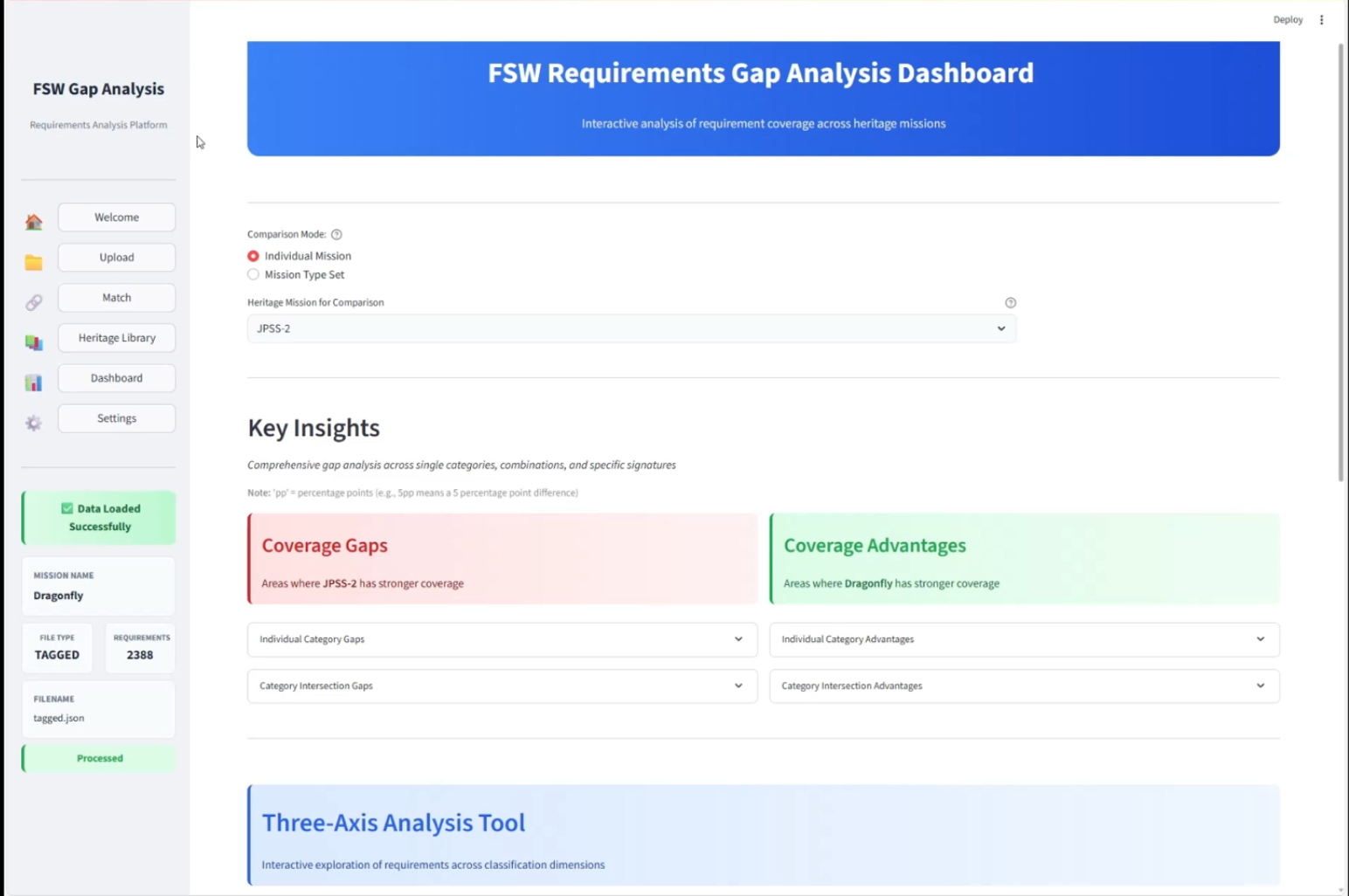
Automated gap detection with visual dashboards and actionable recommendations
The web interface makes the sophisticated analysis accessible to engineers without requiring deep knowledge of the underlying AI models or data processing pipeline.
Impact & Outcomes
Project Outcomes
- ✓Presented findings and demonstrated the tool to NASA Flight Software and Systems Engineers at JPL, NASA Marshall Space Center, and Kennedy Space Center
- ✓Tool distributed to multiple NASA centers for operational use by systems engineers
- ✓Enabled systematic, data-driven assessment of requirement set completeness for future missions
This project demonstrated how modern AI and NLP techniques can be applied to traditional systems engineering challenges, providing engineers with powerful new tools for ensuring mission-critical documentation is complete and comprehensive.